
Nazal Staphylococcus aureus Taşıyıcılığı ve Periprostetik Enfeksiyonlar Arasındaki İlişki
Cilt 31, Sayı 1
Şubat 2017 · Sayfalar 039-044
Nazal Staphylococcus aureus Taşıyıcılığı ve Periprostetik Enfeksiyonlar Arasındaki İlişki
Relation Between Nasal Carriage of Staphylococcus aureus And Periprosthetic Infections
Murat GÜRGER1, Halil SARAÇ2, Şükrü DEMİR3
2Tatvan Devlet Hastanesi, Ortopedi ve Travmatoloji, Bitlis, TÜRKİYE
3Elazığ Eğitim ve Araştırma Hastanesi, Ortopedi ve Travmatoloji Kliniği, Elazığ, TÜRKİYE
Amaç: Ortopedik cerrahide enfeksiyonlar çok yıkıcı sonuçlara neden olabilmektedir. Hastalar uzun süre hastanede yatmakta, antibiyotik kullanmakta ve revizyon cerrahilere maruz kalabilmektedir. Bu durum ek morbiditeye ve hatta mortaliteye neden olabilmektedir.
Gereç ve Yöntem: Bu çalışmamızda 2014-2015 yılları arasında kliniğimizde kalça ve diz artroplastisi planlanan toplam 65 hasta, nazal Staphylococcus aureus (S. Aureus) taşıyıcılığı ile cerrahi alan enfeksiyonu arasındaki ilişki araştırılmak üzere prospektif olarak değerlendirildi.
Bulgular: Hastalarımızın 47’si (%77) kadın, 14’ü (%23) erkek idi ve ortalama yaş 68.4±15.1 (range 28-95 years) olarak tespit edildi. Hastalarımızın 16’ sına (%26.2) total kalça replasmanı, 27’sine (%44.3) total diz protezi ve 18’ine (%29.5) parsiyel kalça protezi operasyonu yapıldı. Sekiz (%13.1) hastada nazal S. aureus taşıyıcılığı tespit edildi, 53 (%86.9) hastada ise normal burun florası veya koagülaz negative stafilokok tespit edildi. Dokuz (%14.8) hastada cerrahi alan enfeksiyonu gelişti. Nazal S. aureus taşıyıcılığı olan 8 hastanın 3’ünde cerrahi alanda taşıyıcılıkla ilişkili üreme olduğu tespit edildi ve bu durum istatistiksel olarak anlamlıydı.
Sonuç: Nazal S.aureus taşıyıcılığının farklı coğrafi bölgelerde yaşayan hastalarda farklılıklar gösterebileceği bilinmektedir. Biz de kendi olgularımızdaki nazal S. aureus taşıyıcılığı ve cerrahi alan enfeksiyonu arasındaki ilişkiyi değerlendirdik. Çalışmamızın hizmet verdiğimiz hasta popülasyonunda nazal S. aureus taşıyıcılığı ve periprostetik enfeksiyon arasındaki ilişkinin değerlendirilmesi açısından anlamlı bir çalışma olduğu kanaatindeyiz.
Introduction: In orthopedic surgery, infections can cause very destructive outcomes. Patients are hospitalized for a long time, are exposed to antibiotics and revision surgeries. This can lead to additional morbidity and even mortality.
Materials and Methods: In this study, a total of 65 patients, with planned hip and knee arthroplasty in our clinic between 2014 and 2015, were evaluated prospectively to investigate the relationship between nasal Staphylococcus aureus (S. Aureus) carriage and surgical site infection.
Results: Of the patients, 47 (77%) were female and 14 (23%) were male, and the mean age was 68.4±15.1 years (range= 28-95 years). Total hip replacements were performed in 16 (26.2%) patients, total knee replacement in 27 (44.3%) patients and partial hip replacement in 18 (29.5%) patients. Eight (13.1%) of the patients were nasal S. aureus carriers, and 53 (86.9%) patients had normal nasal flora or coagulase negative staphylococci. Nine (14.8%) patients developed surgical site infection. Three of 8 nasal S. aureus carriers were found to have carriage-associated surgical site infection, and this was statistically significant.
Conclusion: It is known that nasal S. aureus carriage may differ in patients living in different geographical regions. We also assessed the association between nasal S. aureus carriage and surgical site infection in our cases. We believe that this is a significant study regarding the relationship between nasal S. aureus carriage and periprosthetic infection in the patient population we serve..
Giriş
The infections that develop after orthopedic operations can be very catastrophic, because the patients stay in the hospital for a long time, and they are exposed to antibiotics and revision surgeries. This can lead to additional morbidity and even mortality. Orthopedic surgeries are technically difficult and expensive surgeries that require implants. For these reasons, surgical site infections (SSI) are one of the most feared complications in orthopedic surgery [1-3].Surgical site infections can be grouped under two headings: first; superficial SSI including suture abscesses and subcutaneous collections, and secondly deep-seated SSI extending to implant / prosthesis (periprosthetic joint infection (PJI)) (1).
Periprosthetic joint infection is the most common and most serious complication after arthroplasty of the lower extremity [4]. Periprosthetic joint infection is observed approximately in 1% to 2% of patients with primary total hip prosthesis and approximately in 1% to 4% of patients with total knee prosthesis [4]. Methicillin-sensitive S. aureus (MSSA), methicillin-resistant S. aureus (MRSA) and coagulase-negative staphylococci (CNS) were isolated from approximately 63% of patients with developed SSI [5]. Molecular DNA analyzes have revealed that the organisms responsible for most of the existing SSIs were found in the normal nasal flora of the patient [6]. In order to prevent SSIs, risk factors must be identified and appropriate precautions must be taken [7]. There are strong epidemiological associations between SSIs associated with S. aureus and nasal S. aureus carriage. Carriers carry 2-9 times more SSI risk than non-carriers [8-
As the SSI is known to be associated with many factors, comorbidities that might particularly cause susceptibility to infection (diabetes mellitus, inflammatory arthritis etc.) were questioned. At the same time, data such as American Society of Anesthesiologists (ASA) score and body mass index (BMI), which are thought to be associated with infection, were recorded for evaluation.
All patients were followed up monthly in the first 3 months after surgery and every 3 months in the following months. Patients who had SSI within the first year after surgery were considered as PJI (11). A definite diagnosis of PJI was made by an isolated pathogen by culture from at least two separate tissue or fluid samples obtained from the affected prosthetic joint, or the presence of sinus tract communicating with the prosthesis, elevated serum erythrocyte sedimentation rate (ESR) and serum C-reactive protein (CRP) concentration, and elevated synovial leukocyte count or synovial neutrophil percentage (PMN%) (4). Culture negative PJI was not detected in any of the patients.
For the statistical analyzes, SPSS (Statistical Package for Social Sciences) for Windows 22.0 program was used. Pearson's chi square test was used to compare culture-related reproduction in nasal Staphylococcus aureus carriage, as well as descriptive statistical methods (frequency, percent, mean, standard deviation). Relations were evaluated by Spearman's correlation coefficient. The results were evaluated with a 95% confidence interval and a significance level of P<0.05.
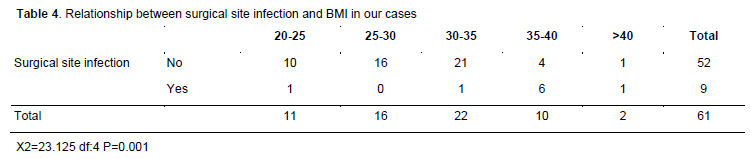
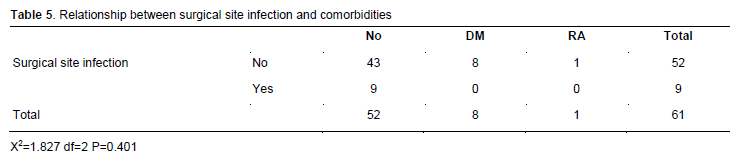
Three of 8 patients with nasal S. aureus carriage were found to have a carriage-related SSI, and this was statistically significant (X2= 20.903 df= 1 P= 0.002). No statistically significant results were found when the relationship between SSI and ASA scores was evaluated (Table 3). When the relationship between SSI and BMI was evaluated, a statistically significant difference was found particularly in patients with high BMI (Table 4). The relationship between SSI and comorbidities was evaluated. No association was found between SSI and comorbidities in 9 patients (Table 5).
It has been shown in clinical series that nasal S. aureus carriers have increased risk of infection and that nasal carriage is an important way of endogenous contamination [8,14]. The relation between S. aureus carriage and increased orthopedic SSI has also been shown in many studies [15-19]. It is known that nasal S. aureus carriage may differ in patients living in different geographical regions [5]. We prospectively assessed the association between nasal S. aureus carriage and SSI in our cases. Nasal S. aureus carriage was detected in 13.1% of our cases. This ratio varies between 20% and 40% in the literature [5]. Surgical site infection associated with nasal carriage was detected in 3 (4.9%) of our cases.
Nasal flora is a source for S. aureus. The interaction between mucin carbonhydrates and staphylococcal proteins provides a suitable environment for colonization of these bacteria on the mucin surface [20]. Although preoperative nasal mupirocin ointment has been shown to reduce the risk of S. aureus related SSI in some studies [21-24], this procedure has been found to be ineffective in other studies [25,26]. Recent studies have shown that rinsing the nose with disinfectants and administering nasal mupirocin ointment is a combination that reduces MRSA-associated infection risk [27,28]. We did not use prophylactic nasal antibiotics and antiseptic administration in our patients. This is the limitation of our study. The wider series comparing decolonized and non-decolonized groups will be the next step in our work.
A definitive preoperative diagnosis of periprosthetic infections is necessary for proper treatment and follow-up, but this is a difficult process. Culture can be affected from many factors such as antibiotic use, biofilm formation, inability to provide the environment to produce rare organisms, and contamination [29-32]. Serological tests, including ESR and CRP, can be used in the preoperative evaluation of PJI, but their low specificities reduce their diagnostic value [29,33,34]. Many combinations of methods have been used for the diagnosis of PJI [31,32,35-38]. The most commonly used diagnostic criteria are purulent discharge or presence of sinus tract, serology, positive culture and histological analysis [29,31,35,36]. When we evaluated our cases in terms of periprosthetic infection, we used the criteria defined by Parvizi et al. [4].
There are many studies demonstrating that prolonged surgical procedure, diabetes mellitus and rheumatoid arthritis, ASA grade and BMI increase the risk of infection in orthopedic surgeries and other surgical interventions [35,39]. However, in our study, no significant relationship was found between aforementioned parameters and periprosthetic infection. The most important reason for this is the fact that the number of our patients is not sufficient to assess this relationship.
Although there are many limitations of our study, we believe that it is a pioneering study in the evaluation of the relationship between nasal S. aureus carriage and periprosthetic infection in our geographical location and in the patient population we serve.
Gereç ve Yöntem
This is a prospective clinical trial that has been carried out following the approval of the local ethics committee. Sixty-five patients scheduled for total hip prosthesis, partial endoprosthesis and total knee replacement operation between 2014 and 2015 were included in the study after informed consent was obtained. The study was conducted on 61 patients, as 4 patients died within the first year after surgery because of non-infectious causes. Prior to surgery, swabs were taken from both nasal mucosae of the patients with cotton swabs soaked with sterile saline. Samples were delivered to the microbiology laboratory the same day, using transport mediums. These specimens were incubated for 24 hours at 37ºC in 5% sheep blood agar. Colony morphology, gram staining and catalase assays were used to isolate staphylococci from generated microorganisms, and coagulase test and mannitol agar were used for S. aureus identification. The methicillin susceptibility test against isolated S. aureus strains was investigated by disk diffusion method.Bulgular
Of the patients, 47 (77%) were female and 14 (23%) were male, and the mean age was 68.4±15.1 years (range=28-95 years). Total hip replacements were performed in 16 patients (26.2%), total knee replacement in 27 patients (44.3%) and partial hip replacement in 18 patients (29.5%) (Table 1). Eight (13.1%) of the patients were nasal S. aureus carriers, and 53 (86.9%) patients had normal nasal flora or coagulase negative staphylococci. Nine (14.8%) patients developed SSI. Five of these patients had superficial SSI and four had deep SSI. The treatments applied to the patients with infection are summarized in Table 2. Infection resolved, and clinical and laboratory values returned to normal after treatment in 7 out of 9 patients who developed SSI. Two patients died during the treatment phase.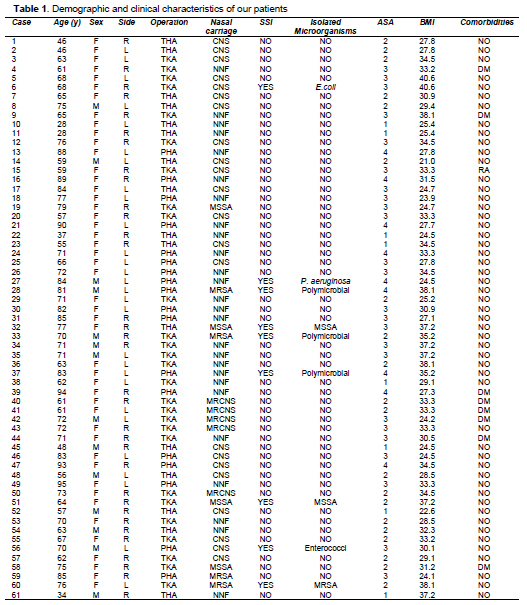


Tartışma
Surgical site infection due to S. aureus is one of the most important complications after hip and knee arthroplasty. Precautions that can be taken before surgery are very important to reduce the incidence of this infection. Aseptic surgical setting and antibiotic prophylaxis reduce the risk of infection, but there is a tendency for this complication to increase worldwide. The increase in the annual number of arthroplasty increases the amount of infection at the same time, which increases the social and economic burden [12,13].References
- Investigation of Nasal Staphylococcus Aureus Carriage and Methicillin Resistance of Hospital Personnel in Kars
- Kars İli Hastane Çalışanlarında Nazal Staphylococcus Aureus Taşıyıcılığı ve Metisilin Direncinin Araştırılması
- A Right-sided Heart Endocarditis and Daptomycine Use in a Patient Who is Not a Injection Drug User: Case Report
- Damariçi Uyuşturucu Kullanım Öyküsü Olmayan Bir Hastada Sağ Kalp Endokarditi ve Daptomisin Kullanımı: Olgu sunumu
- Antibiotic Susceptibility Profile of Staphylococcus aureus Isolates in a Tertiary Care Hospital