
Farelerde Pinealektomi Nedeni ile Azalan Gıda Alımı Melatonin Tarafından Yeniden Düzenlenir
Cilt 28, Sayı 3
Ekim 2014 · Sayfalar 123-127
Farelerde Pinealektomi Nedeni ile Azalan Gıda Alımı Melatonin Tarafından Yeniden Düzenlenir
Melatonin Restores the Decrease in Food Intake Caused by Pinealectomy in Mice
Sinan CANPOLAT1, Haluk KELEŞTİMUR1
Amaç: Bu çalışma farelerde pinealektominin gıda alımı üzerine etkili olup olmadığının belirlenmesi amacıyla yapılmıştır. Gıda alımı üzerine pinealektominin olası etkisine karşılık melatoninin düzenleyici etkisi de araştırılmıştır. Leptinin gıda alımın düzenleyici etkisi üzerine melatoninin bir rolünün olup olmadığını belirlemek için pinealektomize hayvanlarda gıda alımı üzerine leptinin etkisine de bakılmıştır.
Gereç ve Yöntem: Bu çalışmada 30-40 gr ağırlığında yetişkin erkek fareler kullanılmıştır. Hayvanlar her biri 5 hayvandan oluşacak şekilde 2 ana gruba ayrıldı. Kontrol gruba farelere pineal bezinin çıkarılması işlemine benzer şekilde sham operasyon yapıldı. Deney grubunda farelere pinealektomi yapıldı ve iyileşmeleri için iki hafta süre verildi. Farelere günlük i.p olarak melatonin (5 mg/kg/day, i.p.) ve luzindol (10 mg/kg/day, i.p.) uygulandı. Leptin 0.1 mL 15 mM HCl içerisinde 25 μg/fare olacak şekilde i.p olarak enjekte edildi. Kontrol hayvanlarına ise aynı hacimde çözücü maddeler uygulandı.
Bulgular: Pinealektomi farelerde gıda alımında bir azalmaya neden olmuştur. Melatonin ise pinealektomiden kaynaklanan bu gıda alımındaki azalmayı geri çevirmiştir. Melatonin antagonisti olan luzindol ise melatoninin neden olduğu bu artışı geri döndürememiştir. Leptin hem pinealektomize hemde sham-pinealektomize hayvanlarda anlamlı bir şekilde gıda alımını azaltmıştır.
Sonuç: Sonuç olarak melatonin farelerde gıda alımını hem fizyolojik hem de farmakolojik olarak artırmıştır. Melatoninin farelerde gıda alımı üzerine etkilerini hangi mekanizmalar ile gerçekleştirdiğinin belirlenmesi için daha ileri çalışmalara gerek vardır.
Objective: This study was designed to determine whether pinealectomy has an effect on food intake in mice. The efficiency of melatonin in restoring the possible effect of pinealectomy on food intake was also investigated. To determine whether melatonin has a modulatory role in the effect of leptin on food intake, the influence of leptin on food intake in pinealectomized animals were also examined.
Materials and methods: Adult male mice weighing 30-40 g were used in this study. The animals were divided into two main groups, each consisting 5 animals. The mice of the control group were exposed to sham-pinealectomy. In the experimental group, mice were pinealectomized and allowed to recover for a period of two weeks. Mice received daily injections of melatonin (5 mg/kg/day, i.p.) and luzindole (10 mg/kg/day, i.p.). Mice were i.p. injected with leptin in a dose of 25 μg/mouse in 0.1 mL 15 mM HCl. Control animals were injected with the respective vehicle.
Results: Pinealectomy caused a significant decrease in food intake in mice. Melatonin restored this decrease in food intake caused by pinealectomy. Luzindole, a melatonin antagonist, did not reverse melatonin-induced increase in food intake. Leptin significantly decreased food intake in pinealectomized and sham-pinealectomized animals.
Conclusion: In conclusion, melatonin was found to increase food intake physiologically and pharmacologically in mice. Further studies are needed to determine the mechanism by which melatonin exerts its effect on food intake in mice.
Giriş
There is an evidence that melatonin may have an important role in the regulation of food intake besides its well-known functions of photoperiodic regulation of biological rhythms[1], antioxidative[2] and neuroprotective[3] effects. The results of previous studies performed in different species revealed that the effects of melatonin on food intake are controversial. Although there are studies indicating that melatonin has no effect on food intake in rats[4], it has been shown that the effects of melatonin on food intake are dose-dependent, decreasing at high doses[5] and increasing at low and mid-doses[6]. Melatonin has no direct effect on food intake but may have an indirect hyperphagic effect due to suppression of 5-HT2A mediated activation of HPA axis[7]. A higher food intake was reported in pinealectomized rats, which suggests that melatonin may physiologically have a reducing effect on food intake[8]. The pineal gland has been reported to have a stimulatory effect on the ventromedial hypothalamic nucleus, which is known to be a satiety center in hypothalamus[9]. Melatonin can inhibit food intake in some other species, e.g. hamsters[10], which are seasonal breeders, and goldfish[11] as seen in rats. Melatonin has been reported to stimulate food intake in mice[12] and tundra voles[13] in contrast to its effects in rats and hamsters.Melatonin may have a role in the regulation of food intake due to its effects on the hormones regulating food intake. Adipose tissue is also an important target for several hormones, including melatonin[14]. Melatonin has been reported to affect leptin[15,16] and ghrelin release[11,17], which are the main hormones having a role in food intake.
The present study was designed to determine whether pinealectomy has an effect on food intake in mice. The efficiency of melatonin in restoring the possible effect of pinealectomy on food intake was also investigated. To determine whether melatonin has a modulatory role in the effect of leptin on food intake, the effect of leptin on food intake in pinealectomized animals were also examined.
Gereç ve Yöntem
Adult male mice weighing 30–40 g (Firat University Experimental Research Centre, Elazig) were used in this study. They were maintained under controlled light (12-h light and 12-h dark) and temperature (21±1 °C) conditions. Food and water were supplied ad libitum. The food contained crude matter (93.69%) consisting of fish flour, corn, wheat, barley and minerals. All the protocols in the present study were approved by the local ethics committee of the Medical School.Melatonin (Sigma, St Louis, MO, USA) and luzindole (Acros Organics, Belgium) were dissolved in ethanol and further diluted in saline to give a final ethanol concentration of 5%. Mice received daily injections of melatonin (5 mg/kg/day, i.p.) and luzindole (10 mg/kg/day, i.p.). Mice were i.p. injected with leptin (Sigma, mouse recombinant) in a dose of 25 μg/mouse in 0.1 mL 15 mM HCL. Control animals were injected with the respective vehicle (0.5 ml 15 mM HCL and 0.3 mL 7.5 mM NaOH). The drugs were i.p. injected between 9:00 a.m. and 10:00 a.m.
The animals were divided into two main groups, each consisting of 5 animals. The mice of the control group were exposed to sham-pinealectomy. In the experimental group, mice were pinealectomized and allowed to recover for a period of two weeks. These animals intraperitonally (i.p.) received daily injections of melatonin for 5 days. Then, luzindole, a melatonin receptor antagonist, was i.p. given together with melatonin for 5 days and then i.p. injections of leptin were carried out for the last five days. The mice belonging to the control group were injected with only vehicles that were used for melatonin, luzindole or leptin injections. During the experimental period, food intake and body weights were measured.
Mice were anaesthetized by i.p. injection of ketamin (100 mg/kg) plus xylazine (5 mg/kg) and placed in a stereotaxic frame. Pinealectomy was performed as follows: Briefly, a longitudinal midline incision was made above the skull. By means of a dental drill, a rectangular piece of skull bone was removed. The dura was then cut. The superior sagittal sinus was ligated with surgical threads and resected. Pineal gland was exposed beneath the confluence sinuum by retracting the caudal portion of the ligated superior sagittal sinus posteriorly, and removed with a miniature forceps. The procedure was completed by returning the reflected superior sagittal sinus to its original position, re-apposing the dura and closing the wounds. Sham-pinealectomy was conducted almost identically, except pineal gland left intact. Mice were placed in individual cages. Food intake was measured between 9:00 a.m. and 10:00 a.m. each day. The animals were weighed daily.
The data were statistically analysed by Wilcoxon Signed Ranks Test. Level of significant was set at P<0.05. Results are expressed as g/day and presented as means±S.E.M.
Bulgular
Pinealectomy caused a significant decrease in food intake compared to the values of pre-operation during the first 5 days of the experimental period. As can be seen in Figure 1B, intraperitoneal injection of melatonin reversed this effect, resulting in a significant increase in food intake. Neither vehicle injection nor sham operation caused any significant effect on food intake (Figure 1A).
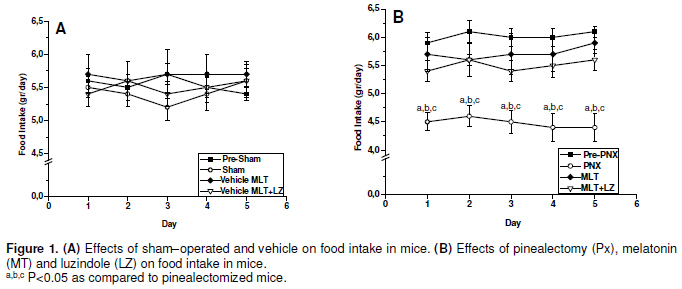
Five days after melatonin injection, a combination of luzindole and melatonin injections did not have a significant reducing effect on food intake, i.e. food intake level was similar to the melatonin treatment level (Figure 1B).
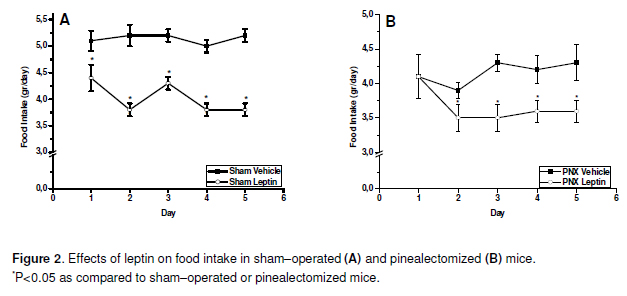
After the treatment of melatonin combined with luzindole, food intake continued to decrease for another period of 5 days. Then, leptin injection caused a further significant decrease in food intake (Figure 2A-2B). There was no significant difference between leptin–injected pinealectomized and sham–operated animals compared to respective vehicle–injected groups.
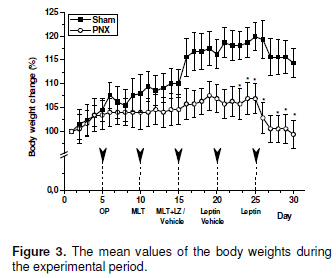
As shown in Figure 3, body weights increased slightly from the experimental period. Only, leptin administration caused a significant decrease in the last 5 days. The mean values of the body weights decreased from 38.12±0.1 and 36.84±0.09 to 37.96±0.27 and 34.9±0.2 g in sham–operated and pinealectomized animals, respectively.
Tartışma
Our results demonstrate that melatonin has a stimulatory effect on food intake in mice. The previous studies also showed that melatonin treatment increased food intake in mice[12]. To determine whether or not melatonin may regulate food intake physiologically, pinealectomy was performed. The pinealectomized animals had lower food intake, which shows melatonin may have an effect on food intake not only pharmacologically but also physiologically as well. Neither vehicles nor sham operation caused any significant changes in food intake.Melatonin may have a role in the regulation of food intake for many reasons. Our previous studies[15,16] and other studies[4,18], showed that melatonin decreases serum leptin levels in rats. The leptindecreasing effect of melatonin is expected to lead to higher food intake because diminution of leptin stimulates food intake. In the present experiment, the stimulatory effect of melatonin on food intake might occur due to the influence of melatonin on leptin release although the levels of serum leptin have not been measured.
The fact that melatonin has different effects on food intake in animal species may be due to its different effects on ghrelin secretion. Ghrelin is known to increase appetite of rodents[9]. In the animal species such as rats in which melatonin decreases plasma ghrelin levels[17], it has an inhibitory effect on food intake whereas melatonin treatment results in a higher food intake in the voles[13]. The stimulatory effect of melatonin on food intake in the voles may have been mediated via elevated ghrelin levels of the melatonin-treated animals.
Melatonin has been suggested to be useful for the treatment of neoplastic cachexia in human because melatonin was found to stimulate appetite by decreasing TNF secretion[20]. Determination of the effect of melatonin on the appetite - regulating hormone such as leptin and ghrelin in human may help the exact mechanism by which melatonin exerts its effect on appetite to be established.
To determine the mechanism by which melatonin exerts its stimulatory effect on food intake in mice, a melatonin antagonist, luzindole (MT2 receptor antagonist) was used. Luzindole did not reverse the increase in food intake caused by melatonin. It was suggested that Melatonin shows an inhibitory effect on food intake in rat[14] and goldfish via luzindole-sensitive melatonin receptors[11]. Thus, stimulatory and inhibitory effects of melatonin appear to be mediated by different mechanisms.
Plasma glucose concentration has an important role in the regulation of food intake. As plasma glucose concentration increases, brain satiety mechanisms are stimulated[21] resulting in a decrease in food intake or vice versa. It has been reported that pinealectomy leads to an increase in plasma glucose concentration[22], which may cause a decrease in food intake. So, the decrease in food intake following pinealectomy may have resulted from an increase in plasma glucose concentration, which stimulates brain satiety mechanisms. In that study, melatonin replacement has been shown to restore 24-h mean plasma glucose concentrations in pinealectomized rats.
In the present experiment, leptin administration resulted in a lower food intake in both shampinealectomized and pinealectomized rat. The efficiency of leptin in reducing food intake were similar in the two groups, which shows pinealectomy did not cause a further enhancement in the effect of leptin on food intake.
The body weights of the animals were daily measured during the experimental study. Until leptin injection, which was performed on 25 day, the body weights of the groups tended to increase. Leptin injection decreased body weights in sham–operated and pinealectomized animals. Percentage decrease in body weight was higher in the pinealectomized group (5.2%) compared with sham-operated group (0.4%). Thus, melatonin seems to prevent leptin-induced decrease in body weight.
In conclusion, melatonin was found to increase food intake physiologically and pharmacologically in mice. Further studies are needed to determine the mechanism by which melatonin exerts its effect on food intake in mice.
Acknowledgements
The authors thank Dr. Bayram Yilmaz of University at
Yeditepe, Faculty of Medicine, Department of Physiology
for his critical review of the manuscript.
References
- Forsling ML, Stoughton RP, Zhou Y, Kelestimur H, Demaine C. The role of the pineal in the control of the daily patterns of neurohypophysial hormone secretion. J Pineal Res 1993; 14: 45-51.
- Baydas G, Gursu F, Cikim G, et al. Effects of pinealectomy on the levels and the circadian rhythm of plasma homocysteine in rats. J Pineal Res 2002; 33: 151-155.
- Kilic E, Ozdemir YG, Bolay H, Kelestimur H, Dalkara T. Pinealectomy aggravates and melatonin administration attenuates brain damage in focal ischemia. J Cereb Blood Flow Metab 1999; 19: 511-516.
- Wolden-Hanson T, Mitton DR, Mccants RL, et al. Daily melatonin administration to middle-aged male rats suppresses body weight, intraabdominal adiposity, and plasma leptin and insulin independent of food intake and total body fat. Endocrinology 2000; 141: 487-497.
- Terrón MP, Delgado-Adámez J, Pariente JA, et al. Melatonin reduces body weight gain and increases nocturnal activity in male Wistar rats. Physiol Behav 2013; 13; 118: 8-13.
- Jahnke G, Marr M, Myers C, et al. Maternal and developmental toxicity evaluation of melatonin administered orally to pregnant Sprague Dawley rats. Toxicol Sci 1999; 50: 271-279.
- Raghavendra V, Kulkarni SK. Melatonin reversal of DOIinduced hypophagia in rats; possible mechanism by suppressing 5-HT(2A) receptor-mediated activation of HPA axis. Brain Res 2000; 31:112-118.
- Zanoboni A, Forni A, Zanoboni-Muciaccia W, Zanussi C. Effect of pinealectomy on arterial blood pressure and food and water intake in the rat. J Endocrinol Invest 1978; 1: 125-130.
- Peschke D, Teichmann J, Peschke E. Pineal influence on annual nuclear volume changes in ventromedial hypothalamic nucleus (VMH) neurons of the male Wistar rat. Chronobiol Int 2000; 17: 15-28.
- Bartness TJ, Wade GN. Body weight, food intake and energy regulation in exercising and melatonin-treated Siberian hamsters. Physiol Behav 1985; 35: 805-808.
- Pinillos ML, De Pedro N, Alonso-Gomez AL, Alonso- Bedate M, Delgado MJ. Food intake inhibition by melatonin in goldfish (Carassius auratus). Physiol Behav 2001; 72: 629-634.
- Bubenik GA, Pan SF. The role of serotonin and melatonin in gastrointestinal physiology: ontogeny, regulation of food intake, and mutual serotonin-melatonin feedback. J Pineal Res 1994; 16: 91-99.
- Mustonen AM, Nieminen P, Hyvarinen H. Melatonin and the Wintering Strategy of the Tundra Vole, Microtus oeconomus. Zoolog Sci 2002; 19: 683-687.
- Zanuto R, Siqueira-Filho MA, Caperuto LC, et al. Melatonin improves insulin sensitivity independently of weight loss in old obese rats. J Pineal Res 2013; 55:156-165.
- Baydas G, Gursu F, Canpolat S, et al. Effects of pinealectomy on the circadian release pattern of leptin in male rat. Neuroendocrinol Lett 2001; 22: 449-452.
- Canpolat S, Sandal S, Yilmaz B, et al. Effects of pinealectomy and exogenous melatonin on serum leptin levels in male rat. Eur J Pharmacol 2001; 428:145-148.
- Mustonen AM, Nieminen P, Hyvarinen H. Preliminary evidence that pharmacologic melatonin treatment decreases rat ghrelin levels. Endocrine 2001; 16: 43-46.
- Rasmussen DD, Boldt BM, Wilkinson CW, Yellon SM, Matsumoto AM. Daily melatonin administration at middle age suppresses male rat visceral fat, plasma leptin, and plasma insulin to youthful levels. Endocrinology 1999; 140: 1009-1012.
- Melis MR, Mascia MS, Succu S, et al. Ghrelin injected into the paraventricular nucleus of the hypothalamus of male rats induces feeding but not penile erection. Neurosci Lett 2002; 329: 339-343.
- Lissoni P, Paolorossi F, Tancini G, et al. Is there a role for melatonin in the treatment of neoplastic cachexia? Eur J Cancer 1996; 32: 1340-1343.
- Riediger T, Schmid HA, Lutz TA, Simon E. Amylin and glucose co-activate area postrema neurons of the rat. Neurosci Lett 2002; 328: 121-124.
- La Fleur SE, Kalsbeek A, Wortel J, Van Der Vliet J, Buijs RM. Role for the pineal and melatonin in glucose homeostasis: pinealectomy increases night-time glucose concentrations. J Neuroendocrinol 2001; 13: 1025-1032.
- The Effects of Incremental Exercise Test on Leptin Concentration in Obese Patients
- OBEZ HASTALARDA ŞİDDETİ DÜZENLİ OLARAK ARTAN YÜKE KARŞI YAPILAN EGZERSİZİN SERUM LEPTİN DÜZEYİ ÜZERİNE ETKİLERİ
- Protective Effect of Melatonin on Oxidant and Antioxidant Systems in Ethanol-Induced Liver Damage
- ETANOL İLE OLUŞTURULMUŞ KARACİĞER HASARINDA MELATONİNİN OKSİDAN VE ANTİOKSİDAN SİSTEMLER ÜZERİNDEKİ KORUYUCU ETKİSİ
- Effects of Pinealectomy and Melatonin on brain ischemia – reperfüzyon induced morphologic changes in rats