Amaç: Sistosel ve stres inkontinans saptanan olgularda kullanılan polypropylene mesh
sonuçlarının değerlendirilmesi.
Gereç ve Yöntem: Çalışma grubunu sistosel ile birlikte stres inkontinans saptanan 26 olgu
oluşturdu. Internatinal Continence Society (ICS) sınıflamasına göre sistoselleri evre 2 veya daha
fazla idi. Tüm olgulara rutin testler ile birlikte ürodinamik incelemeler yapıldı. Tüm olgularda 4 kollu
polypropylene mesh ile midüretra ve mesane desteği sağlandı. Postoperatif 1. ayda ICIQ-SF
doldurtuldu. Hastalar postoperatif komplikasyonlar açısından 1 yıl takip edildi.
Bulgular: Yirmi altı olgunun yaş ortalaması 52.3±11, postoperatif ortalama takip süresi 13.1±8.7 ay
idi. Postoperatif sistosel rekurrensi veya stres inkontinans semptomları izlenmedi. Post operatif
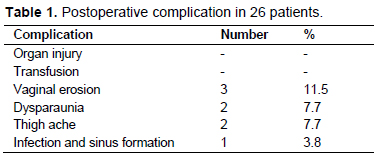
başarı oranı %100 olarak kabul edildi. Üç olguda (%11.5) vaginal erozyon, iki olguda (%7.7)
disparauni, iki olguda uyluk ağrısı ve bir olguda genitofemoral alandaki giriş yerinde enfeksiyon ve
sinus formasyonu izlendi. ICIQ-SF skorları 14.9±2.4'den postoperatif 1. ayda 5.2±4.7'ye düştü (p<
0.01).
Sonuç: Sistosel ve stres inkontinanslı olgularda tek bir polypropylene mesh ile mesane ve
midüretra takviyesi başarılı, etkili, düşük morbiditeli ve iyi tolere edilen bir yöntem olarak kabul
edilebilir.
Objective: The aim of this study was to assess the use of polypropylene mesh for treatment of
cystocele and stress urinary incontinence.
Material and Methods: The study group included 26 cases who have cystocele and stress urinary
incontinence. Patients with stage 2 or more cystocele, classified according to Internatinal
Continence Society (ICS) classification, were included into this study. Routine tests and
urodynamic studies performed for all cases. Miduretra and bladder support was provided by 4-arm
polypropylene mesh in all cases. The follow-up period was 1 year for post-operative complications
and ICIQ-SF scores were recorded at one month.
Results: The mean age of the 26 cases were 52.3±11 and postoperative mean follow up was
13.1±8.7 months. There were no cystocele recurrence and stress urinary incontinence symptoms
at the postoperative period. The success rate was considered 100% for this surgery. Vaginal
erosion was detected in three cases (11.5%).Two cases (7.7%) complained of dispareunia. Thigh
pain occurred in two cases, one patient had infection at trocar insertion point in the genitofemoral
fold and sinus formation occurred in one patient. ICIQ-SF scores significantly decreased from 14.9
± 2.4 to 5.2 ± 4.7 at postoperative first month (p < 0,01) .
Conclusion: The usage of only one polypropylene mesh for the support of bladder and midurethra
in cases with cystocele and stres urinary incontinence may be accepted as a successful and
effective method with low morbidity and well tolerability.
Giriş
Classical Anterior colporrhaphy operation which is used for cystocele is associated
with an unacceptably high recurrence rate. Paravaginal repairs are technically more
difficult to perform and may be associated with more complications. Because of these
reasons mesh use has become more prevalent for anterior vaginal operations[1].
In recent years, transobturator techniques which are accepted as less invasive
operations, subtitude for invasive- Tension-free vaginal tape (TVT) operations. In this
study, we presented four arm polypropylene mesh operation results that is used to
support bladder and midurethral defects in patients suffering from grade-II or more
cystocele and stress urinary incontinence.
Gereç ve Yöntem
The study group included 26 cases who have grade-
II or more cystocele with stress urinary incontinence.
Patients having cystocele with stage 2 or more according
to Internatinal Continence Society (ICS) classification,
were included in the study group[2]. All patients
underwent a complete urologic, gynecologic and
urodynamic work-up before the surgical treatment.
Patients with complaints of stress incontinence or mixed
incontinence were included into the study group.
Furthermore patients having first degree uterine
prolapsus and/or rectocele were also included. Patients
with urge incontinence or mixed incontinence having
urge symptoms were excluded.
Four arm polypropylene macropore mesh ( Nasca,
Promedon, Arjantina) has been used for all cases.
Vaginal mucosa peel off from bladder by median incision
that began just beneath 1.5 cm from the urethra.
Outside-in transobturatory procedure were used for
lateral arms to pass the fasia. Fore arms of the mesh
were passed subcutaneously through lateral sides of the
urethra and they were hooked to suprapubic region.
Bladder and midurethra were reinforced by the mesh.
Finally one part of vaginal mucosa were cauterized and
sutured via the double-breasted technic.
During the surgery antibiotic prophylaxis was
administered via single 1g intravenous dose of
cefozoline. Patients were discharged at postoperative
day one after removal of the urinary catheter and
observing no residual urine within the bladder. Followup
visits were performed at 1, 3 and 6 months
postoperatively.
Operation was accepted as succesful when there
were no cystocele or only stage 1 cystocele.
Improvement was defined as a significant reduction in
urine leakage, such that it did not require further
treatment. ICIQ-SF filled by the patients were compared
preoperatively and at postoperative first month.
Statistical analysis
Results are expressed as mean+SD. Pre- and posttreatment
values of the parameters were compared with
a paired sample t-test. The relationships between
different variables were analysed with Pearson
correlation test. The statistical analysis was carried out
by using Statistical Package for the Social Sciences
(SPSS), version 11.0 (SPSS, Chicago, IL). A p-value of
0.05 was considered to be statistically significant.
Bulgular
Twenty-six patients completed the study protocol.
The follow-up period was 1 year for post-operative
complications and ICIQ-SF scores were recorded at one
month. The study was approved by the local ethics
committee. Mean age was 52,3 ± 11,0 years (range, 36-
71 years). Mean follow-up period was 13,1±8,7 months
(range 1-29 month). Preoperative mean ICIQ-SF scores were 14,9 ± 2,4 at postoperative period mean score 5,2
± 4,7 significantly decreased (p < 0,01) .
We used four arm polypropylene monofilament
macroporous mesh for supporting the bladder and
midurethra in all patients. At the same time 3 patients
had rectosel so posterior colpoperinearaphy procedure
were added. Bladder, urethra or vascular complications
didn't occur. In our study, the surgical cure rate was
found 100% for cytocele repair and for stres urinary
incontinence.
Vulvar ecchymosis was encountered in a patient at
post operative period. We found regional ache at point of
mesh arm entry in two patients. Two other patients had
dysparaunia and mesh tension at vaginal sulcus. During
the postoperative follow-up period three patients had
erosion at the level of midurehtral incision (11,5%). We
resected mesh partially and the redundant mucosa was
excised then the mucosa re- sutured. Infection and sinus
formation was detected at genitofemoral fold trocar
insertion point in one patient, (Table 1). In this case local
excision was performed and medication was
administered.
Table 1: Postoperative complication in 26 patients.
Tartışma
Vaginal anterior repairing and Kelly plication is the
classical procedure for treatment of cystocele[3]. Central
defects are generally repaired via fasial plication. In
addition to these operations, paravaginal reinforcement
and Burch colposuspesion can be used[4]. However,
this procedure needs laparotomy which extends
hospitalization during this operation. Vaginal operations
are preferred because of short hospitalization period and
with minimal morbidity[5].
Severe cystocele repair should include correction of
bladder herniation and without obstruction and retention.
Tension-free mesh is placed under the bladder wall and
resistance to intrabdominal pressure is increased at the
same time with permenant reinforcement of bladder
basement,neck and side walls[6].
We didn't detect any recurrence of symptomatic
cystocele or stage 1 cystocele after operation in our 26
patients with stage 2 or more cystocele. ICIQ-SF scores
significantly decreased in the postoperative period
(14.9±2.4 versus 5.2±4.7) in our study group (p < 0,01).
Flood et al.[7] assessed the use of Marlex mesh in
conjunction with anterior colporrhaphy for the correction
of cystocele with or without urinary stress incontinence in
142 patients. Their mean follow-up time was 3.2 years.
No patients experienced recurrent anterior vaginal wall
prolapse but three of their patients (2.1%) developed
mesh erosions in the vagina. There was a 74% success
rate in the treatment of urinary stress incontinence. In our
study we had also three patients with vaginal erosions
(11.5%). Since, initially we had no enough experience
with this technique in our hospital, a relatively high
complication rate appeared in our study.
Yan et al.[8] studied cystocele repair by the
placement of a synthetic subvesical mesh secured
anteriorly through the obturator foramen in 30 patients.
They only found failure in a young patient (3%) after a
mean follow-up of 6.7 months. Two vaginal erosions
(7%) were observed at six and nine months
postoperatively. Two cases (14%) complained of anterior
dysparaunia.
Granese et al.[9], repaired moderate or severe
cystocele with Y-shaped mesh placed on the perivesical
fascia. After a follow-up of 24 months,19 patients (11%)
reported recurrent cystocele, 9 patients (5.1%) had a
vaginal wall erosion after 6 month follow up and 2
patients (1%) complained of persistent dyspareunia.
Palanca et al.[10], used polypropylene mesh for the treatment of cystocele in 31 cases whose mean age was
62.3 year. They found no patient with prolapse
recurrence.
Park et al.[11] reported success rate of cystocele
repair as 90% and stress incontinence was cured in all
patients (100%). The postoperative complication was
transient voiding difficulty in 2 cases after mean follow up
7.1 month in.
The use of mesh in operations isn't always safe.
Cicatrix formation and erosion rate was reported to be
6% in some series[12,13]. Infection, pain, seroma,
fıstula and sinus formation were reported to be other
complications in mesh operations. Type 1 monofilament
polypropylene macroporous mesh should be preferred
because of low complication rates[13].
As a conclusion, the use of one piece of
polypropylene mesh for the support of bladder and
midurethra in cases with combined cystocele and stres
urinary incontinence may be accepted as a successful,
effective method of treatment with low morbidity and well
tolerebility.
References
Nguyen JN. The use of grafts for anterior vaginal prolapse
repair:pros and cons. Current Opin Obstet Gynecol 2008;
20: 501-505.
Weber AM, Abrams P, Brubaker L, Cundiff G. et al. The
standardization of terminology for researchers in female
pelvic floor disorders. Int Urogynecol J 2001; 12: 178-186.
Kelly HA, Dumm WM. Urinary incontinance in women
without manifest injury to the bladder. 1914. Int Urogynecol
J Pelvic Floor Dysfunct 1998; 9: 158-164.
Burch JC. Urethrovaginal fixation to Cooper's ligament for
correction of stres incontinance, cystocele and prolapse.
Am J Obstet Gynecol 1961; 81: 281-290.
Raz S, Little NA, Juma S, Sussman EM. Repair of severe
anterior wall prolapse grade IV cystourethrocele. J Urol
1991; 146: 988-992.
Migliari R, Usai E. Treatment results using a mixed fiber
mesh in patients with grade IV cystocele. J Urol 1999; 161:
1255-1258.
Flood CG, Drutz HP, Waja L. Anterior colporrhaphy
reinforced with Marlex mesh for the treatment of
cystoceles. Int Urogynecol J Pelvik Floor Dysfunct 1998; 9:
200-204.
Yan A, Anne M, Karine A, et al. Cystocele repair by a
synthetic vaginal mesh secured anteriorly through the
obturator foramen. Eur J Obstet Gynecol Reprod Biol 2004;
15: 115: 90-94.
Granese R, Adile B. Tension free cystocele repair: an
analysis after a follow up of 24 months. Minerva Gynecol
2007; 59: 369-376.
Palanca BA, Perez CF, Zaragoza QJA, et al. Cystocele
repair with a polypropylene mesh: our experience. Arch
Esp Urol 2004; 54: 391-396.
Park HK, Paick SH, Lee BK, et al. Initial experience with
concomitant prolif system and tension free vaginal tape
procedures in patients with stres urinary incontinence and
cystocele. INJ 2010; 14: 43-47.
Debodinance P, Delporte P, Engrand JB, Boulogne M.
Development of better tolerated prosthetic materials:
applications in gynecolgical surgery. J Gynecol Obstet Biol
Reprod 2002; 31: 527-540.
Cosson M, Debodinance P, Boukerrou M, et al. Mechanical
properties of synthetic implants used in the repair of
prolapse and urinary incontinance in women which is the
ideal material? Int Urogynecol J Pelvic Floor Dysfunct
2003; 14: 169-178.